Modernizing Automated Pipeline Vulnerability Assessment Through DevSecOps Certified Professional (DSOCP) Technical Principles
Introduction
DevSecOps Certified Professional (DSOCP) is a rigorous validation of engineering proficiency designed to bridge the structural divide between software development, IT operations, and corporate cybersecurity. This technical field guide is written directly for practicing software engineers, infrastructure architects, reliability leads, and technology directors who seek an authentic, production-grade roadmap for integrating automated guardrails across modern software delivery cycles. The engineering ecosystem has evolved beyond isolated teams and manual security approval gates; cloud-native systems demand security controls implemented directly within pipelines and cluster runtimes. Understanding where security intersects with continuous deployment, modern platform engineering, and enterprise cloud architecture is now critical for sustainable operational reliability. This guide analyzes every technical facet, curriculum boundary, assessment mechanism, and organizational outcome tied to the credential, helping professionals make objective, career-defining decisions regarding their technical education, whether they operate in India or across global software organizations.
What is the DevSecOps Certified Professional (DSOCP)?
The DevSecOps Certified Professional (DSOCP) program represents a hands-on, credentialed verification designed to prove an engineer can construct resilient, self-healing, and compliant continuous integration and continuous deployment ecosystems. Unlike purely theoretical examinations that test multiple-choice memorization of regulatory frameworks, this credential demands demonstrated capability in configuring automated inspection tools, managing vulnerability prioritization, and hardening containerized runtimes. It reflects modern software delivery paradigms where security controls function as automated unit tests rather than delayed bureaucratic audits.
The certification curriculum emphasizes running security testing directly inside operational pipelines without slowing down developer cycle velocity. Candidates learn to treat security policies as programmatic declarations, evaluating code quality, third-party libraries, container layers, and virtual network definitions automatically. This operational standard ensures systems withstand real-world attack vectors, satisfy corporate audit requirements, and preserve deployment speed across enterprise infrastructures.
Who Should Pursue DevSecOps Certified Professional (DSOCP)?
This professional certification targets software developers, system administrators, site reliability engineers, cloud platform builders, and cybersecurity analysts who intend to eliminate functional silos across the delivery lifecycle. Experienced engineers with several years of exposure to Linux environments, source code management, and primary public cloud platforms will extract substantial technical depth from this coursework, using it to transition toward high-demand infrastructure architecture roles. Early-career practitioners who possess sound fundamentals in programming and basic CI/CD concepts can utilize the structured roadmap to accelerate their ascent into dedicated platform and pipeline engineering tracks.
Engineering managers, team leads, and security governance directors also derive significant organizational value by understanding how automated testing tooling integrates smoothly into developer routines. For technical personnel operating within India’s rapid digital infrastructure hubs as well as those collaborating with distributed multinational enterprises, this certification offers an internationally respected benchmark that proves an individual can modernize software delivery practices and safeguard digital business assets effectively.
Why DevSecOps Certified Professional (DSOCP) is Valuable
The demand for engineers capable of securing continuous deployment workflows continues to outpace the availability of qualified infrastructure talent across enterprise sectors. Traditional approaches that treat system protection as a post-production sign-off have created severe deployment bottlenecks, resulting in costly remediation cycles and frequent public outages. Organizations now actively invest in professionals who design automated preventative mechanisms directly into the deployment pipeline, ensuring that every merged commit undergoes rigorous static, dynamic, and container baseline analysis.
This technical skill set remains durable across fluctuating industry cycles because foundational pipeline security principles do not change when underlying cloud tools evolve. Whether an enterprise transitions across cloud platforms or replaces container orchestration frameworks, the operational necessity of managing secret distribution, evaluating dependency risks, and enforcing runtime protection boundaries remains unchanged. Mastering these engineering competencies protects an engineer against technical obsolescence while delivering an exceptional return on educational time and effort.
DevSecOps Certified Professional (DSOCP) Certification Overview
The DevSecOps Certified Professional (DSOCP) program is offered directly through DevOpsSchool, serving as an authoritative, industry-aligned verification framework. The learning curriculum is engineered around practical competency, utilizing real-world pipeline scenarios, container environments, and enterprise scanning infrastructures rather than abstract multiple-choice scenarios. Each module requires candidates to establish running pipelines, integrate automated scanners, analyze resulting vulnerability payloads, and implement programmatic remediation controls.
Candidates undergo thorough evaluations testing their practical abilities to diagnose configuration flaws, rectify container base image vulnerabilities, and secure Kubernetes runtimes under simulated production conditions. The program governance is managed by seasoned platform specialists and security architects who routinely update the curriculum to address current threats, software supply chain risks, and emerging compliance standards. This disciplined assessment architecture guarantees that certified professionals hold genuine engineering capabilities that translate immediately to real-world corporate infrastructure.
DevSecOps Certified Professional (DSOCP) Certification Tracks & Levels
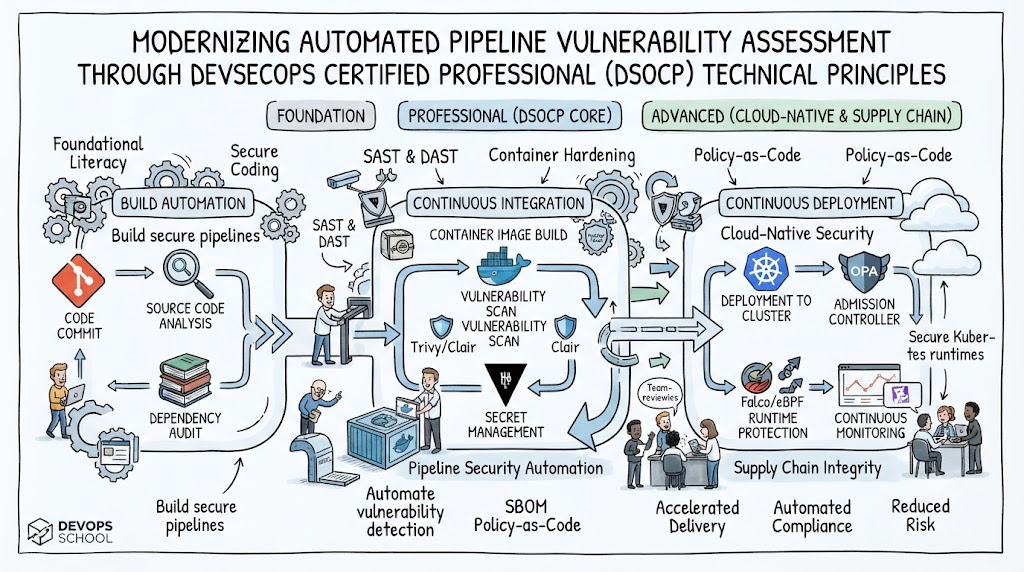
The DevSecOps learning ecosystem is structured across three deliberate evolutionary stages: Foundation, Professional, and Advanced. The Foundation tier establishes core literacy, introducing candidates to the mechanics of automated pipelines, source code management safety, basic cryptography, and the fundamental philosophy of shifting security inspections toward the earliest stages of the development cycle. This entry tier guarantees that candidates possess the baseline skills required for deeper programmatic security work.
The Professional tier, anchored by the DevSecOps Certified Professional (DSOCP) credential, immerses engineers in the hands-on engineering challenges of pipeline security automation, container hardening, dynamic runtime testing, and automated compliance auditing. Beyond this level, Advanced certifications specialize into dedicated disciplines, allowing engineers to pursue deep architectural tracks including Enterprise Cloud Security, Container Security Architecture, and Automated Governance Engineering. These tiers align directly with engineering career trajectories, guiding a professional smoothly from foundational infrastructure support toward enterprise-level technology leadership.
Complete DevSecOps Certified Professional (DSOCP) Certification Table
| Track | Level | Who it’s for | Prerequisites | Skills Covered | Recommended Order |
| Security Fundamentals | Foundation | Junior Developers, QA Engineers, Junior Admins | Basic Linux and Git knowledge | Static code analysis, basic CI/CD, dependency audits, cloud basics | Step 1 |
| Core DevSecOps Engineering | Professional | DevOps Engineers, SREs, Security Analysts | 1-2 years CI/CD and script automation | SAST, DAST, SCA, Secrets Management, Docker security, Jenkins/GitLab | Step 2 |
| Cloud-Native Security | Professional | Cloud Engineers, Platform Architects | Linux, Docker, and AWS/Azure/GCP fundamentals | Kubernetes RBAC, Network Policies, OPA Gatekeeper, Admission Controllers | Step 3 |
| Software Supply Chain | Advanced | Lead Engineers, DevSecOps Consultants | Professional pipeline and cloud knowledge | SBOM generation, Sigstore Cosign, SLSA framework, artifact signing | Step 4 |
| Threat Modeling & Architecture | Advanced | Solutions Architects, Security Directors | Deep understanding of distributed applications | Automated threat modeling, compliance as code, chaos security | Step 5 |
Detailed Guide for Each DevSecOps Certified Professional (DSOCP) Certification
DevSecOps Certified Professional (DSOCP) – Core Engineering
What it is
This credential validates an engineer’s practical capability to architect, configure, and manage comprehensive security testing automation within modern enterprise CI/CD systems. It certifies that the candidate can successfully integrate automated vulnerability detection tools into pipelines without interrupting delivery speeds.
Who should take it
This course is structured for practicing DevOps engineers, platform professionals, infrastructure administrators, and software developers who carry at least one to three years of experience with build automation and seek to master production pipeline security.
Skills you’ll gain
- Implementation of automated Static Application Security Testing (SAST) engines within build workflows.
- Configuration of Software Composition Analysis (SCA) to detect outdated and vulnerable third-party libraries.
- Management of centralized secret storage, automated rotation, and dynamic credential delivery to running applications.
- Hardening and scanning of container images throughout automated image registries and continuous delivery pipelines.
- Execution of Dynamic Application Security Testing (DAST) across staging environments using automated tools.
Real-world projects you should be able to do
- Construct a complete GitLab or Jenkins continuous delivery pipeline that halts deployment builds whenever high-severity CVE vulnerabilities appear in application dependencies.
- Configure a centralized HashiCorp Vault cluster to dynamically generate and distribute short-lived cloud database credentials to microservices.
- Build an automated container compilation workflow that minimizes base image attack surfaces using distroless images and signs build artifacts using public key pairs.
Preparation plan
- 7–14 days plan: Focus strictly on high-impact pipeline scanner integrations; run local Docker instances of SonarQube, Trivy, and OWASP ZAP; review key pipeline configuration syntaxes and vulnerability severity ratings.
- 30 days plan: Build three end-to-end pipelines incorporating SAST, SCA, and DAST tools; configure automated secret injection inside continuous deployment runners; execute practical container remediation exercises.
- 60 days plan: Architect a distributed deployment ecosystem across a multi-stage Kubernetes cluster; implement policy-as-code governance engines; write custom scanning scripts to intercept non-compliant software configurations prior to release.
Common mistakes
- Focusing exclusively on scanning tool installations while neglecting to write automated policy rules that determine when builds must fail.
- Hardcoding sensitive access credentials inside configuration scripts during initial deployment pipeline setup.
- Ignoring false-positive triage strategies, leading to alert fatigue that prompts development teams to bypass automated checks.
Best next certification after this
- Same-track option: Certified Container Security Expert
- Cross-track option: Certified Kubernetes Security Specialist (CKS)
- Leadership option: DevSecOps Enterprise Program Director
DevSecOps Certified Professional (DSOCP) – Cloud-Native Security
What it is
This credential certifies an engineer’s operational ability to harden container runtimes, configure cluster boundary protection, and enforce automated operational policies across distributed Kubernetes environments.
Who should take it
Targeted at Site Reliability Engineers, Cloud Infrastructure Architects, and Platform Engineers who already possess working knowledge of container management systems and need to secure orchestration layers against internal and external attack vectors.
Skills you’ll gain
- Enforcement of Kubernetes Role-Based Access Control (RBAC) following least-privilege engineering models.
- Configuration of programmatic Network Policies to establish microsegmentation between cluster namespaces.
- Deployment and tuning of Open Policy Agent (OPA) Gatekeeper to govern pod admission standards.
- Runtime threat detection and anomaly interception using kernel-level observability tooling such as Falco.
- Cluster encryption management, covering both operational storage volumes and internal inter-service network transit.
Real-world projects you should be able to do
- Deploy a security admission controller inside a production Kubernetes cluster that blocks any container image originating from unapproved registries or executing with root permissions.
- Author an enterprise-wide network segmentation policy that restricts pod-to-pod communications across sensitive database namespaces.
- Establish a real-time behavioral monitoring system using eBPF probes that streams security alerts to centralized management dashboards whenever unexpected shell executions occur within pods.
Preparation plan
- 7–14 days plan: Review core Kubernetes architecture, focusing extensively on API server authentication, service account tokens, and standard security contexts.
- 30 days plan: Configure multi-tenant Kubernetes clusters from scratch; manually write complex network policies; deploy OPA Gatekeeper constraint templates and test admission behavior against non-compliant pod manifests.
- 60 days plan: Build automated cluster hardening pipelines incorporating CIS Benchmark evaluation scripts; implement full service-mesh mutual TLS (mTLS) configurations; write custom Falco alerting rules for unusual operational activity.
Common mistakes
- Permitting containers to run with elevated root privileges simply to simplify access to host directories.
- Leaving Kubernetes API servers publicly exposed without restricting endpoint access through strict network access control lists.
- Relying on default namespace configurations that permit unrestricted, unmonitored communication between all cluster workloads.
Best next certification after this
- Same-track option: Advanced Kubernetes Runtime Defender
- Cross-track option: Site Reliability Engineering Certified Professional
- Leadership option: Cloud Security Infrastructure Lead
DevSecOps Certified Professional (DSOCP) – Software Supply Chain Security
What it is
This advanced validation confirms an engineer’s capability to protect the full software development lifecycle from upstream source code compromise, untrusted dependencies, pipeline tampering, and malicious build injections.
Who should take it
This course is structured for Senior Release Engineers, DevSecOps Specialists, and Enterprise Platform Architects tasked with meeting stringent corporate governance mandates and securing modern software distribution networks.
Skills you’ll gain
- Generation, parsing, and management of Software Bills of Materials (SBOM) using modern industry formats like CycloneDX and SPDX.
- Cryptographic signing and programmatic verification of build outputs using keyless signing utilities like Sigstore Cosign.
- Implementation of the Supply-chain Levels for Software Artifacts (SLSA) framework across enterprise build systems.
- Auditing and locking down third-party dependencies using repository proxy managers and internal secure artifact registries.
- Continuous verification of code provenance from source commit to production deployment.
Real-world projects you should be able to do
- Construct a secure, automated build system that automatically generates an authenticated SBOM for every compiled application artifact and stores it within an enterprise metadata store.
- Configure continuous delivery controllers to verify cryptographic build signatures and reject container images that lack verified provenance attestations.
- Establish an automated dependency management pipeline that scans, isolates, and mirrors approved open-source libraries into internal proxy repositories.
Preparation plan
- 7–14 days plan: Master SBOM format specifications; conduct practical exercises using open-source tools like Syft, Grype, and Cosign on local development machines.
- 30 days plan: Integrate signature validation mechanisms into standard CI/CD runners; build policy verification gates that check for complete artifact attestations before deployments proceed.
- 60 days plan: Design an enterprise-grade secure software distribution architecture adhering to SLSA Level 3 specifications; configure tamper-proof build pipelines with immutable provenance generation.
Common mistakes
- Generating SBOM documents during the build phase without actively evaluating their contents inside production deployment gate checks.
- Storing signing keys alongside build scripts where unauthorized build engineers can easily compromise them.
- Assuming private registry hosting alone protects third-party packages from upstream repository poisoning.
Best next certification after this
- Same-track option: Enterprise Secure Architecture Specialist
- Cross-track option: MLOps Pipeline Security Practitioner
- Leadership option: Chief Information Security Officer Transition Program
Choose Your Learning Path
DevOps Path
The DevOps trajectory focuses on building rapid, automated delivery pathways that transform raw source code into dependable production assets. Engineers walking this path master configuration management, infrastructure automation, and automated testing frameworks to deliver frequent, low-risk releases. Security is integrated systematically as automated validation checkpoints, ensuring that deployment velocity remains unhindered by operational controls. This path is ideal for developers and infrastructure operators who want to build end-to-end continuous deployment environments.
DevSecOps Path
The DevSecOps trajectory centers on embedding security controls directly into the software development lifecycle from the earliest stages of planning. Practitioners on this track specialize in automating static code analysis, vulnerability management, container protection, and runtime observability within build and delivery systems. The focus shifts from manual security auditing toward treating security policy as automated, version-controlled code. This engineering path is tailored for professionals who aspire to eliminate the traditional conflict between rapid product shipping and strict compliance obligations.
SRE Path
The Site Reliability Engineering trajectory applies software engineering solutions directly to infrastructure stability and operational challenges. Engineers focus on uptime metrics, latency reduction, automated incident remediation, and establishing objective Service Level Objectives (SLOs) alongside actionable error budgets. Security in this discipline represents a fundamental component of system availability, treating unauthorized alterations and vulnerabilities as operational outages. This path serves systems engineers who want to manage complex, self-healing distributed cloud applications at enterprise scale.
AIOps Path
The AIOps path focuses on applying machine learning algorithms, statistical telemetry analysis, and event correlation engines to modern IT operational infrastructure. Practitioners learn to ingest massive streams of application metrics, centralized log repositories, and distributed trace events to detect system degradation before service disruption occurs. Engineers streamline automated root-cause analysis, significantly reducing mean time to remediation across complex, distributed microservice environments. This specialization is designed for operational engineers aiming to automate incident management using data-driven intelligence.
MLOps Path
The MLOps path bridges the operational gap separating data science experimentation from reliable, production-grade machine learning model deployment. Engineers mastering this track manage model versioning, automated training pipelines, model registry validation, and automated inference monitoring under variable traffic conditions. Security within MLOps involves securing sensitive training data sets, guarding against adversarial input attacks, and maintaining complete lineage tracking from raw data to deployed model weights. This path is suited for software and infrastructure engineers supporting enterprise machine learning deployments.
DataOps Path
The DataOps path applies continuous integration and agile delivery principles directly to data ingestion pipelines, analytical data warehouses, and automated reporting systems. Professionals learn to automate data quality validation, monitor pipeline performance metrics, and manage complex schema migrations without causing downstream service interruptions. Security focuses on automated data masking, role-based database permissions, and meeting regulatory compliance requirements throughout the analytical data lifecycle. This path is engineered for data specialists who want to replace brittle, manual data transfers with robust, automated data platforms.
FinOps Path
The FinOps path introduces operational financial accountability to cloud infrastructure engineering, blending technical deployment decisions with financial stewardship. Practitioners learn to configure real-time cloud expenditure monitoring, establish automated cost optimization policies, and implement resource tagging architectures across public cloud environments. The objective is to empower engineering squads to optimize application performance while keeping infrastructure costs transparent, predictable, and aligned with core business metrics. This path is ideal for systems leads, engineering directors, and cloud finance analysts.
Role → Recommended DevSecOps Certified Professional (DSOCP) Certifications
| Role | Recommended Certification Track | Core Focus Area | Primary Career Milestone |
| DevOps Engineer | Core DevSecOps Engineering | Pipeline Security & Automation | Automated Shift-Left Implementation |
| SRE | Cloud-Native Security | Cluster Defense & Observability | Resilient Runtime Infrastructure |
| Platform Engineer | Software Supply Chain Security | Provenance & Artifact Attestation | Golden Path Internal Developer Platforms |
| Cloud Engineer | Cloud-Native Security | IAM, Network Policies, Encryption | Secure Infrastructure as Code Foundations |
| Security Engineer | Core DevSecOps Engineering | Automated Scanner Orchestration | Developer-Centric Security Tooling |
| Data Engineer | DataOps & Pipeline Defense | Data Ingestion Pipeline Integrity | Safe Analytical Architecture Delivery |
| FinOps Practitioner | FinOps & Security Governance | Resource Auditing & Cost Control | Optimized, Secure Cloud Economics |
| Engineering Manager | DevSecOps Executive Strategy | Organizational Transformation | Scalable Delivery Governance Models |
Next Certifications to Take After DevSecOps Certified Professional (DSOCP)
Same Track Progression
Advancing within the dedicated DevSecOps specialization demands moving from standard pipeline configurations toward advanced architectural defense and governance automation. Engineers should pursue specialized accreditations in advanced runtime security, eBPF-based kernel observability, and comprehensive software supply chain protection. These advanced qualifications validate your capability to protect complex multi-tenant environments, construct custom security compliance tooling, and defend distributed systems against sophisticated zero-day exploits. Staying within this focused path establishes your reputation as a high-tier enterprise security authority capable of resolving challenging infrastructure vulnerabilities.
Cross-Track Expansion
Broadening your technical competencies into adjacent engineering disciplines creates a versatile, highly resilient career profile. Professionals holding DevSecOps credentials gain immense operational value by completing advanced Site Reliability Engineering programs or mastering modern Platform Engineering architectures. Learning how to build self-service internal developer platforms, enforce automated service level objectives, and manage large-scale Kubernetes estates balances your technical profile. This cross-disciplinary skill set prepares you to design resilient, highly automated cloud delivery ecosystems that combine deployment speed, platform stability, and robust security safeguards.
Leadership & Management Track
For senior practitioners transitioning from day-to-day configuration scripts toward strategic leadership, educational progression must emphasize engineering governance, team leadership, and executive communication. Pursuing technology management certifications, enterprise security leadership accreditations, or strategic cloud architecture programs refines your organizational management skills. These programs prepare senior engineers to manage multi-disciplinary teams, establish enterprise-wide engineering roadmaps, negotiate tool licensing budgets, and align technical risk mitigation directly with corporate business performance.
Training & Certification Support Providers for DevSecOps Certified Professional (DSOCP)
DevOpsSchool
DevOpsSchool operates as an industry-recognized training and enterprise coaching institution dedicated to delivering high-impact, practical education across DevOps, SRE, and cloud-native security disciplines. Their technical curriculum is curated by practicing engineers who emphasize hands-on terminal exercises, live production simulations, and real-world system troubleshooting over passive conceptual learning. Students gain direct access to extensive lab environments covering modern build automation, container registries, dynamic testing tools, and Kubernetes platforms. The organization has successfully trained thousands of engineers worldwide, providing continuous support, detailed architectural walkthroughs, and relevant project work that equips candidates to implement production-grade DevSecOps workflows immediately within enterprise environments.
Cotocus
Cotocus delivers focused technology consulting, specialized corporate upskilling, and professional certification guidance targeted at modernizing software delivery operations. Their learning programs center on solving concrete infrastructure challenges, including modernizing legacy deployment pipelines, migrating systems toward secure cloud platforms, and automating continuous compliance checks. Instructors emphasize real-world engineering pragmatism, ensuring that course attendees learn to evaluate security trade-offs, configure resilient monitoring systems, and streamline collaboration across engineering departments. With an emphasis on practical implementation, Cotocus provides a dependable educational foundation for technical personnel seeking to attain industry credentials and succeed in fast-paced software delivery roles.
Scmgalaxy
Scmgalaxy serves as an established technical knowledge community and education provider centered on source configuration management, build engineering, and modern DevOps tooling ecosystems. It offers an expansive catalog of technical tutorials, curated operational guides, and structured mentoring sessions designed to help engineers master complex version control strategies and continuous delivery automation. Their coursework covers practical integration between code repositories, static analysis platforms, and continuous integration engines, helping engineers build a robust foundation in pipeline architecture. The platform remains an exceptional educational destination for practitioners aiming to solidify their understanding of software configuration control and secure continuous deployment workflows.
BestDevOps
BestDevOps functions as an informative resource network and professional training portal dedicated to tracking, reviewing, and teaching modern software delivery methodologies. The organization focuses on demystifying complex cloud engineering frameworks, offering clear technical paths for professionals advancing through DevOps, platform engineering, and automated security roles. Through hands-on exercises, tool comparison guides, and structured certification preparation modules, learners develop the technical competence necessary to evaluate, deploy, and maintain modern software delivery tooling. Their training approach highlights real-world efficiency, enabling software practitioners to eliminate operational friction and accelerate release cadences without compromising technical quality.
devsecopsschool.com
devsecopsschool.com is a dedicated technical educational platform focusing exclusively on the integration of automated security practices throughout the modern software engineering lifecycle. The curriculum concentrates strictly on practical pipeline defenses, vulnerability lifecycle management, automated compliance validation, and container security controls. Candidates engage directly with production-grade tooling, learning to configure automated scanners, manage sensitive enterprise secrets, and implement policy-as-code engines. By maintaining an exclusive, specialized focus on the DevSecOps discipline, this portal provides candidates with deep, targeted insights and technical training required to master modern software supply chain defense and earn professional security credentials.
sreschool.com
sreschool.com specializes in curriculum dedicated to Site Reliability Engineering, distributed systems resilience, and enterprise-scale observability architectures. The platform teaches technical professionals how to transform traditional operational practices using software engineering paradigms, establishing actionable Service Level Objectives, measuring error budgets, and automating incident remediation workflows. Training modules feature deep explorations of distributed tracing, log aggregation frameworks, system performance tuning, and chaos engineering simulations. For engineers pursuing a balanced understanding of how system security directly impacts overall production reliability and availability, this focused institution provides exceptional, real-world educational resources.
aiopsschool.com
aiopsschool.com focuses on the intersection of artificial intelligence, machine learning algorithms, and enterprise IT infrastructure operations. The educational programs instruct engineers on how to deploy automated telemetry processing engines, reduce alert fatigue, and automate root-cause analysis across distributed application estates. Learners work directly with algorithmic event correlation frameworks, predictive capacity planning tooling, and intelligent incident response systems. The school equips contemporary operations engineers and reliability practitioners with the advanced analytical capabilities needed to manage increasingly complex, high-velocity computing environments where manual troubleshooting is no longer viable.
dataopsschool.com
dataopsschool.com provides targeted technical education designed to introduce agile development workflows, continuous integration, and automated quality assurance to data engineering pipelines. The institution guides practitioners through the design and maintenance of automated, self-testing data platforms, eliminating brittle manual handoffs across large-scale analytics environments. Students learn to automate database schema migrations, implement continuous data quality assertions, manage data versioning systems, and enforce data privacy compliance programmatically. This specialized training empowers data engineers and database administrators to deliver dependable, production-grade data pipelines that meet modern enterprise business intelligence requirements.
finopsschool.com
finopsschool.com is an educational platform committed to teaching cloud financial management, infrastructure economics, and data-driven resource optimization. The curriculum teaches engineering leads, cloud architects, and operations professionals how to bridge the gap between technical infrastructure choices and business financial objectives. Students learn to design granular cloud billing architectures, implement automated resource rightsizing scripts, configure anomaly detection for cloud spending, and build clear cost allocation models. By establishing a culture of shared financial accountability, the school ensures organizations maximize the business value of their cloud infrastructure investments while maintaining peak operational performance.
Frequently Asked Questions (General)
1. How difficult is the DevSecOps Certified Professional (DSOCP) examination?
The assessment is structured to test genuine technical execution rather than basic rote memorization, giving it a moderate to advanced level of difficulty. Candidates must demonstrate practical skill in setting up automated pipelines, fixing security scanner misconfigurations, and resolving live vulnerabilities across container environments.
2. What are the essential prerequisites required before attempting this credential?
Candidates should possess a working knowledge of Linux operating system administration, basic shell scripting skills, foundational understanding of Git version control, and familiarity with core continuous integration tools like Jenkins, GitLab, or GitHub Actions.
3. How much study time is typically required to pass the certification?
An experienced DevOps or systems engineer spending ten to fifteen hours per week can prepare thoroughly within four to six weeks. Practitioners who are newer to container runtimes and automated security tools generally require eight to ten weeks of structured laboratory practice.
4. Does this certification focus on specific vendor tools or open-source solutions?
The certification curriculum prioritizes widely adopted open-source tooling, including SonarQube, OWASP ZAP, Trivy, and HashiCorp Vault, alongside standard container utilities. This ensures the engineering principles you learn remain applicable across any proprietary cloud vendor or custom internal enterprise toolchain.
5. How does this credential impact salary potential and career growth?
Professionals who hold verified credentials in automated security pipelines frequently command compensation premiums over generalist developers and infrastructure engineers. The scarcity of engineers who understand both delivery velocity and security architecture makes this qualification an effective accelerator for platform engineering and architecture promotions.
6. Is this certification recognized internationally by enterprise organizations?
Yes, because the curriculum focuses on fundamental engineering principles like shifting security left, securing container images, and managing software supply chains, the credential holds immediate credibility across North America, Europe, India, and other major technology centers worldwide.
7. Can a software developer benefit from this credential, or is it exclusively for operations teams?
Software developers benefit significantly because modern engineering organizations require developers to write secure code and understand how automated build tests work. Learning how security scanners evaluate code allows developers to write cleaner, more resilient software and resolve vulnerabilities before merging pull requests.
8. What is the typical recertification period and maintenance policy?
The credential remains valid for a period of two to three years. Certified engineers maintain their active credential status by completing practical continuing education units, clearing brief recertification updates, or passing advanced specialized track examinations within the learning network.
9. How does the program balance theoretical concepts with practical lab exercises?
The program is heavily weighted toward hands-on implementation, dedicating approximately seventy percent of the total curriculum to direct terminal work, scanner installations, and pipeline configuration scripts, with only thirty percent devoted to foundational security architecture theory.
10. What type of computing hardware is required to complete the preparation labs?
A modern workstation equipped with an eight-core processor, sixteen gigabytes of system RAM, and sixty gigabytes of free disk space capable of running local virtualization platforms or Docker Desktop is completely sufficient for practicing all hands-on coursework locally.
11. Is coding knowledge necessary to pass this certification?
Advanced software programming skills are not strictly required, but candidates must be comfortable reading common application structures, editing configuration formats like YAML and JSON, and writing fundamental Bash or Python automation scripts to manage pipeline tasks.
12. How should this certification be sequenced alongside general cloud certifications?
It is ideal to complete an associate-level cloud credential first to establish baseline networking, identity access management, and virtual machine skills, then pursue this DevSecOps credential to master the art of securing automated continuous deployment environments across those cloud systems.
FAQs on DevSecOps Certified Professional (DSOCP)
1. What exact technical competencies are evaluated during the DSOCP assessment?
The DevSecOps Certified Professional evaluation assesses your direct ability to integrate security scanners into automated pipelines, remediate container vulnerabilities, configure secrets management systems, and implement runtime security policies. Candidates are tested on concrete implementation tasks, such as configuring automated static code analysis, executing software composition audits, provisioning least-privilege cloud access rules, and configuring automated build failure alerts. The exam focuses on verifying that you can design, deploy, and maintain security automation without interrupting normal engineering delivery cadences.
2. How does DSOCP differ from traditional enterprise cybersecurity certifications?
Traditional cybersecurity certifications focus heavily on theoretical regulatory frameworks, governance policies, network perimeter defense, and manual post-incident auditing procedures. In direct contrast, DSOCP is an infrastructure and automation credential centered on treating security policies as version-controlled code. Instead of teaching you how to manually audit networks after deployment, it teaches you to build self-healing continuous deployment pipelines that inspect, test, and validate software security automatically at the point of commit.
3. Can I complete the entire DSOCP curriculum and examination remotely?
Yes, the entire instructional curriculum, hands-on laboratory exercises, and official certification examination are delivered online through a fully remote infrastructure. Candidates access pre-configured cloud laboratory environments directly through standard web browsers or terminal sessions, allowing you to practice complex container deployments, pipeline scripts, and vulnerability remediations from any global location with a dependable internet connection.
4. Which specific continuous integration platforms are used throughout the DSOCP program?
The curriculum is engineered to be platform-agnostic, emphasizing core automation concepts that apply universally across all continuous deployment engines. However, practical laboratory exercises prominently feature industry standards like Jenkins, GitLab CI, and GitHub Actions. This approach ensures candidates master the mechanics of pipeline syntax, runner configurations, webhook triggers, and environment secrets across the most prevalent build automation engines used across modern software enterprises.
5. How does the DSOCP program teach secret management and credential handling?
The program covers modern secret management by teaching candidates how to decouple sensitive database passwords, cryptographic keys, and API tokens from application source code. You will gain hands-on experience deploying, configuring, and maintaining centralized secret management platforms like HashiCorp Vault. The curriculum covers automated credential generation, dynamic short-lived token distribution, automated secret rotation, and the programmatic injection of credentials directly into container runtimes without writing plain text to disk.
6. Does the DSOCP credential cover container and Kubernetes security practices?
Yes, container security represents a foundational pillar of the DSOCP certification track. Candidates study the complete container lifecycle, from authoring minimal, secure Dockerfiles to scanning base images for known vulnerabilities using tools like Trivy. Additionally, the curriculum covers Kubernetes runtime protection, teaching you to establish strict pod security standards, author network microsegmentation policies, configure namespace access boundaries, and implement dynamic admission controllers to block non-compliant container deployments.
7. How are software dependencies and open-source library vulnerabilities addressed in DSOCP?
The DSOCP curriculum addresses third-party dependency risks through comprehensive training in Software Composition Analysis (SCA) and modern software supply chain verification frameworks. You will learn to integrate automated tools that parse software dependencies, cross-reference components against public vulnerability databases, and generate standardized Software Bills of Materials. The coursework teaches practical remediation strategies, such as automated library updates, version pinning, and configuring automated pipeline gates that stop builds containing unpatched dependencies.
8. What immediate return on investment can an employer expect from a DSOCP-certified engineer?
Employers gain an engineer who can immediately identify and resolve pipeline security weaknesses, eliminate manual security review bottlenecks, and automate compliance audits across delivery workflows. This technical competence dramatically reduces the risk of security vulnerabilities reaching live production, accelerates software release cycles, and minimizes developer downtime spent on emergency remediation. Certified professionals build automated guardrails that allow development teams to ship features rapidly without compromising system integrity or customer trust.
Final Thoughts: Is DevSecOps Certified Professional (DSOCP) Worth It?
Engineering teams no longer debate whether security belongs inside deployment pipelines; modern operational reality has made automated security testing an absolute technical necessity. The DevSecOps Certified Professional (DSOCP) program strips away marketing jargon and focuses squarely on the difficult, necessary work of building secure, automated continuous deployment environments. It does not teach you how to fill out compliance spreadsheets or memorize regulatory legal codes; it teaches you how to run static analysis tools, configure secret distribution systems, harden container clusters, and write build scripts that protect software systems automatically.
Pursuing this qualification makes complete sense if you are willing to spend significant time working at the command line, configuring testing engines, and troubleshooting pipeline failures. It requires real effort to understand how automated scanners work and how to tune policies without overwhelming software developers with false alerts. If your goal is to master practical cloud-native defense, eliminate operational silos, and build robust, automated software delivery architectures, this credential provides a clear, proven, and highly practical path forward for your engineering career.
Leave a Reply