Core Skills Required To Monitor And Troubleshoot Complex Distributed Cloud Applications Successfully
Introduction
Site Reliability Engineering helps keep computer programs running without errors. Modern apps need high stability because people use them every single day. A broken app makes people upset. This work blends writing software code with fixing computer servers. When servers break, smart code can fix them fast. In this guide, you will learn how systems stay healthy. You will also see how engineers stop crashes before they happen. Platforms like SRESchool.in share helpful guides on these key topics. Learning these basic ideas gives you strong digital skills.
What Is Site Reliability Engineering?
Site Reliability Engineering means using code to make big systems run smoothly. Its main purpose is to keep websites alive and fast. We call this uptime, which simply means the website is open for visitors. Stability means the site does not shake, glitch, or fall over. Engineers use automation to complete boring tasks with scripts instead of human hands. They also set up monitoring, which acts like a watchful eye on servers. If a server gets sick, the monitoring tool spots it right away. So, the software keeps working well without sudden stops.
Why Does SRE Matter?
People want their phone apps to open fast every single time. Slow apps make people feel angry, so they leave. Downtime happens when a service completely stops, which hurts normal business. Companies lose money and user trust when their systems break often. Good reliability engineering stops repeat crashes by finding root causes early. Teams spot small bugs before they grow into giant outages. Because of this quick action, customers stay happy and keep using the service.
What Does an SRE Engineer Do?
A Site Reliability Engineer protects system health every day. These engineers track live screens that show server speeds and memory use. They handle alerts when a machine runs out of room. Next, they solve incidents, which are sudden system emergencies. Think of a fire truck rushing to put out a fire. The engineer puts out the fire, but then removes the dry wood so no new fire starts. They write code to automate dull jobs, and they plan ahead so servers never run out of space.
What Is SRE Training?
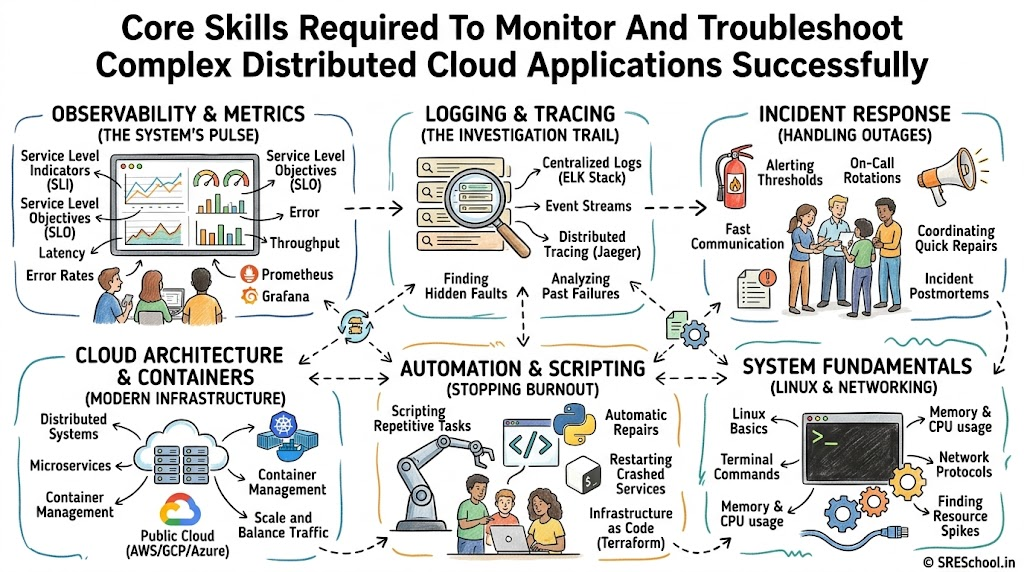
Good SRE Training teaches people how to keep systems online. Students learn Linux first, which is a computer operating system that runs most web servers. Next, they study observability, which means seeing what happens deep inside software. Learners also study three key words: SLIs, SLOs, and SLAs. A Service Level Indicator, or SLI, measures real service speed. A Service Level Objective, or SLO, is the goal target set by the team. A Service Level Agreement, or SLA, is a formal promise made to paying users. Learners also study error budgets, which count how many small mistakes an app can safely make each month. They use containers to package code neatly, and they use Kubernetes to manage those containers.
| Measurement Concept | Simple Meaning | Real Life Example |
| SLI | Real test score | App speed right now |
| SLO | Internal goal score | Target 99% fast responses |
| SLA | Official promise | Contract refund if broken |
| Error Budget | Safe wiggle room | Five minutes of test time |
Why Consider SRE Certification?
An SRE Certification shows that you understand core reliability rules. It gives learners a clear map to follow step by step. Tests help you check what you know and find your weak spots. But a paper certificate alone does not guarantee a job. Real teams want people who can fix broken systems under pressure. Because of this, you must build real projects along with your studies. Hands-on practice and study paths work best when paired together.
What Should an SRE Course Include?
A clear SRE Course guides a beginner from simple ideas to advanced skills. First, you learn basic computer terms and Linux commands. Next, you set up basic monitoring tools and simple alerts. Then, you learn to track real goals using clear SLIs and SLOs. After that, you practice handling live system emergencies calmly. Later, you manage cloud servers, software containers, and auto-scaling tools. Finally, you write scripts to manage full cloud networks safely.
SRE Training in India
More tech companies in India now build giant cloud services for worldwide users. Because of this growth, teams need skilled people to manage production setups. Many engineers in India work with teams spread across different time zones. They must keep global apps fast, safe, and online at midnight. SRESchool.in helps regional engineers build these hands-on operational skills. Practical learning helps people run large cloud systems with high confidence.
SRE Tools
Engineers use specialized tools to inspect and repair digital platforms. Each tool handles one part of the reliability job.
| Tool Area | What It Does | Example Use |
| Monitoring | Tracks system health | Check server errors |
| Logging | Records system events | Find hidden software bugs |
| Tracing | Tracks user requests | Find slow code lines |
| Alerting | Sends urgent warnings | Wake up on-call staff |
| Infrastructure | Manages cloud systems | Build servers with code |
| Containers | Packages software apps | Run apps anywhere safely |
Tools like Kubernetes run containers across many computers at once. Terraform writes code to build new cloud machines in minutes. Observability tools collect logs and traces so you can see errors right away.
SRE Best Practices
Teams must follow clear SRE Best Practices to keep software healthy. First, set clear goals so everyone knows how fast the app should run. Next, track only useful metrics so screens stay clean and readable. Also, send alerts only when an engineer must take real action. Too many noisy alerts make tired people miss real emergencies. You must test every system update before users see it. When accidents happen, hold a review meeting to learn lessons without blaming any single person.
Real-Life Scenarios
- The Flash Sale Rush: An online shop holds a giant noon sale. Shoppers flood the store at once, and servers slow down. The engineer sets up auto-scaling scripts, so new servers launch on their own. The website stays online, and every shopper finishes their order.
- The Midnight Alert: A database fills its hard drive at two in the morning. An alert wakes up the engineer on call. The engineer cleans out old logs, restores the service, and then writes a script to delete old files automatically every week.
- The Buggy Code Release: A new code update breaks the checkout button. The monitoring system catches the error rise within twenty seconds. The team rolls back the code to the older safe version right away.
Common SRE Mistakes to Avoid
- Too Many Alerts: Sending alerts for tiny issues wakes people up for no good reason. Fix this by alerting only on broken user features.
- Blaming People: Yelling at people for mistakes makes them hide future bugs. Fix this by studying the process flaw, not the human.
- Manual Repetition: Typing the same fix every week wastes precious hours. Fix this by writing a small script to do the work.
- No Real Goals: Running servers without SLO targets means you cannot measure success. Fix this by picking simple speed goals first.
- Ignoring Error Budgets: Pushing risky updates when the app is already broken creates outages. Fix this by pausing new features until stability returns.
- No Disaster Drills: Waiting for a real crash to test backups brings pure chaos. Fix this by running fake outages once every month.
- Messy Dashboards: Staring at fifty graphs at once confuses on-call staff. Fix this by tracking only the four main signals: speed, traffic, errors, and saturation.
- Skipping Documentation: Keeping recovery tricks inside one person’s head hurts the whole team. Fix this by writing simple recovery steps in shared playbooks.
How SRESchool.in Can Support SRE Learning
Starting a reliability path can feel hard without a clear plan. SRESchool.in offers Site Reliability Engineering Training to help people build real technical habits. Learners explore practical SRE Tutorial guides that explain cloud tools and system safety. The site provides a structured SRE Course covering modern containers, alerts, and automation scripts. It also helps students prepare for Site Reliability Engineering Certification reviews. Beginners can understand hard production problems using simple, step-by-step lessons.
SRE Learning Roadmap
You can master these skills through five simple steps: Learn → Practice → Build → Test → Improve.
First, learn basic computer networks, Linux systems, and small Python scripts. Next, practice installing tools like Docker and Prometheus on your own laptop. Then, build a small website and monitor its uptime with dashboards. After that, test the setup by breaking your own server on purpose. Finally, improve your setup by writing code that fixes those broken parts automatically.
Frequently Asked Questions
1. What is the main goal of Site Reliability Engineering?
Site Reliability Engineering keeps software systems fast, stable, and open for users. It uses software code to fix everyday operational problems. This reduces human labor and prevents repeated service outages across networks. Teams can launch new features quickly while keeping the core system totally safe.
2. Can a beginner start learning SRE without prior coding skills?
Yes, beginners can start learning basic reliability concepts right away. However, learning basic Python or Go scripting will help you advance much faster. Code helps you automate repetitive daily chores. Basic Linux command knowledge is also very helpful for every new learner.
3. How is SRE different from regular DevOps?
DevOps is a wide philosophy that brings developers and system admins together. SRE is a concrete way to practice that teamwork using specific engineering rules. SRE uses clear measurements like SLOs and error budgets to decide when to release software.
4. What are SLIs and SLOs in plain words?
An SLI is a real measurement of service speed, like page load time. An SLO is the internal goal score your team wants to maintain every day. If your SLI falls below your SLO, your team stops new work to fix the stability bug.
5. What does an error budget do for an engineering team?
An error budget defines the small amount of downtime an app can safely suffer. No system can stay perfect all the time. This budget lets developers take smart risks and push new features until the safety room runs out.
6. Why do engineers need to study Linux for SRE?
Most cloud platforms and internet services run on top of Linux servers. Knowing basic Linux commands helps you inspect running tasks, check memory, and review system logs. You cannot fix a server easily if you do not understand its operating system.
7. What are the most common tools every SRE uses?
Engineers use tools like Kubernetes to handle containers and Terraform to build cloud setups. They also rely on Prometheus to collect metrics and Grafana to draw visual charts. These tools help engineers monitor, detect, and resolve outages very quickly.
8. How does automation help a reliability engineer?
Automation replaces boring manual computer chores with smart, repeatable scripts. If a task takes two clicks every morning, a script can run it instead. This saves time and stops human typing mistakes during tense server emergencies.
9. What happens during a post-incident review?
After an outage ends, the team gathers to talk about what broke and why. They never point fingers or blame any single person. Instead, they find the weak process point and write new code guards so the exact problem never returns.
10. Is an SRE certification enough to get hired?
A certification proves you spent time studying core reliability ideas and terms. But companies also want to see real projects and practical computer skills. You should always pair your certificate studies with hands-on lab experiments and personal code samples.
11. Why is observability better than plain monitoring?
Monitoring tells you when a computer system stops working or throws an error. Observability lets you look inside the software to understand why the crash occurred. It connects logs, traces, and metrics so you can trace complex software bugs easily.
12. What does on-call duty mean for an engineer?
Being on call means carrying a pager or phone to respond to server emergencies. If an app breaks at night, the alerting tool rings the on-call engineer. The engineer logs in, finds the bug, and fixes the service for users.
CONCLUSION
Modern apps need strong reliability to keep users happy and businesses healthy every day. Site Reliability Engineering gives teams the tools to stop crashes and fix bugs fast. By learning Linux, monitoring, and smart automation, anyone can master these helpful concepts over time. A focused platform like SRESchool.in provides practical paths for learners to build these modern technical skills. Start by setting small goals, practice with real tools, and build stable projects that run without errors.
Leave a Reply