Comprehensive Guide To Continuous Vulnerability Assessment Strategies Developed By DevSecOpsNow Teams
Engineering leaders build and deploy applications rapidly through multi-cloud environments, container orchestrators, automated CI/CD runners, and open-source ecosystems. However, this hyper-connected software pipeline dramatically expands modern attack surfaces, making traditional end-of-lifecycle security inspections ineffective and costly. When security teams perform audits right before product releases, hidden vulnerabilities cause expensive release delays, operational friction, and unmanaged production hazards. Modern software delivery demands continuous security integration, policy-as-code automation, and embedded compliance frameworks across every software development phase, ensuring engineering teams analyze, scan, and harden code from initial commit to live production.
Understanding DevSecOps
DevSecOps embeds security operations directly into core development workflows, transforming security into a shared daily responsibility across engineering organizations. By shifting security left, developers discover and remediate application defects during early coding phases, drastically cutting software remediation costs. Automated security testing engines integrate straight into version control pipelines, delivering real-time vulnerability feedback inside native pull requests. Modern security platforms deploy Static Application Security Testing (SAST) for source code analysis, Dynamic Application Security Testing (DAST) for live runtime probing, Software Composition Analysis (SCA) for open-source component tracking, and automated secrets scanning to stop credential exposure. Furthermore, teams apply Infrastructure as Code (IaC) checks, container registry scanning, Software Bill of Materials (SBOM) generation, policy-as-code guardrails, and continuous runtime observability across production workloads.
Why Organizations Are Adopting DevSecOps
Modern application architectures rely heavily on Git repositories, continuous integration pipelines, Docker images, Kubernetes clusters, Terraform scripts, and multi-cloud providers including AWS, Azure, and Google Cloud. While these platforms accelerate feature velocity, they expose complex software supply chains through microservice networks, third-party APIs, external libraries, and public container registries. Progressive enterprises adopt DevSecOps to establish continuous threat detection and automated security verification, keeping pace with daily deployments without slowing down release cycles. Embedding automated security gates into developer pipelines enhances cross-team alignment, elevates security visibility, and enforces compliance across regulatory frameworks. Ultimately, proactive security integration accelerates vulnerability patch cycles, minimizes emergency releases, and strengthens software resiliency against modern cyber threats.
DevSecOps Consulting Services
Building scalable security operations requires strategic foresight, technical alignment, and architectural blueprints delivered through specialized DevSecOps Consulting Services. Professional consulting engagements evaluate an organization’s existing development infrastructure, build runners, cloud architectures, and toolchains to locate critical security gaps. Experienced consultants architect custom security strategies aligned with enterprise business targets, compliance frameworks, and specific technical stacks like AWS, Azure, or Kubernetes. By selecting appropriate tools, establishing security governance, and designing cloud defense models, external advisors help engineering teams map clear transformation journeys. Organizations routinely request consulting support when scaling engineering operations, updating legacy pipelines, addressing compliance audit failures, or requiring structured roadmaps to embed security automation smoothly into active development workflows.
DevSecOps Implementation Services
Converting strategic blueprints into active operational capabilities requires precise technical execution provided through DevSecOps Implementation Services. Implementation specialists directly configure automated security scanners, policy guardrails, and continuous compliance checks across developer repositories, build runners, container registries, and cloud deployment pipelines.
Static Application Security Testing – SAST
Static Application Security Testing (SAST) analyzes source code, byte code, and application binaries for structural defects without running the application. Integrating SAST tools into source code managers and CI/CD pipelines allows developers to identify SQL injections, memory leaks, and logic flaws inside active pull requests, enabling instant fixes before code merges into protected branches.
Dynamic Application Security Testing – DAST
Dynamic Application Security Testing (DAST) evaluates running applications from an external perspective to uncover operational security flaws and live vulnerability exposure. Automated DAST tools execute simulated attacks against test environments, identifying broken authentication, session vulnerabilities, cross-site scripting, and request forgery issues that static analysis tools miss entirely.
Software Composition Analysis – SCA
Software Composition Analysis (SCA) continuously inspects project dependencies, open-source packages, and third-party modules to flag known CVEs, outdated code, and open-source licensing risks. SCA engines automatically map deep transitive dependencies, alerting developers immediately when upstream maintainers release critical security patches for third-party libraries.
Secrets Scanning
Secrets scanning platforms monitor code commits, pull requests, commit histories, build scripts, and configuration files for embedded credential data. By discovering hardcoded API keys, database passwords, private encryption keys, and cloud access tokens before commits enter remote repositories, secrets tools prevent dangerous credential leaks across public and enterprise systems.
Infrastructure as Code Security
Infrastructure as Code (IaC) security tools evaluate provisioning templates, including Terraform files, AWS CloudFormation scripts, and ARM templates, for dangerous configuration errors. Automated IaC checks flag unencrypted storage buckets, overly broad firewall rules, and exposed administrative ports long before cloud platforms actually provision those resources.
Container Security
Container security practices defend application workloads across base image selection, image building, registry storage, and runtime deployment. Automated security systems run static scans against container layers to catch OS vulnerabilities, verify digital signatures for image integrity, enforce baseline image standards, and monitor container hosts for malicious runtime behavior.
Kubernetes Security
Protecting cloud-native applications requires domain expertise delivered through Kubernetes Security Consulting Services to harden cluster control planes, worker nodes, and containerized workloads. Practical Kubernetes security focuses on key operational areas, such as Role-Based Access Control (RBAC) to enforce administrative least privilege, Network Policies to isolate pod-to-pod traffic, and Admission Controls to enforce deployment constraints. Technical teams implement secure Secrets Management to protect sensitive data stored in ETCD, apply Container Image Security rules, and harden API server configurations. Additionally, deploying runtime threat detection engines and strict Cluster Access Management controls allows operators to catch container escapes, unauthorized API calls, and suspicious pod activities instantly.
Cloud Security
Securing enterprise applications across AWS, Azure, Google Cloud, and hybrid cloud footprints requires robust engineering practices backed by expert Cloud Security Consulting Services. Cloud security architectures establish granular Identity and Access Management (IAM) controls, strict Cloud Network Security perimeters, and continuous Cloud Configuration Security checks to stop accidental public access. Implementing strong data encryption, unified security logging, and automated Infrastructure as Code Security provides total operational visibility across cloud environments. Furthermore, deploying Cloud Security Posture Management (CSPM) platforms alongside dedicated Workload Security solutions enables security teams to detect drift, verify regulatory standards, and maintain continuous control over distributed multi-cloud assets.
Software Supply Chain Security
Modern applications consist largely of open-source components, making Software Supply Chain Security Services essential for protecting external dependencies, build infrastructure, and release channels against supply chain tampering. Development teams must secure package registries, build runners, artifact repositories, and CI/CD platforms against credential theft and unauthorized code injection. Enforcing digital code signing and verifying artifact checksums throughout build processes guarantees that production deployments contain original, untampered source code. By auditing external maintainers and locking down build environments, engineering organizations establish resilient software supply chains capable of stopping compromised dependencies.
Understanding Software Bill of Materials
A Software Bill of Materials (SBOM) provides a formal, machine-readable inventory listing every third-party component, open-source module, and software license contained within an application. Organizations generate SBOMs to achieve full supply chain transparency, satisfy regulatory standards, and evaluate security exposure rapidly when zero-day vulnerabilities hit open-source software packages. Creating automatic SBOMs during CI/CD build cycles gives security teams accurate component visibility, simplifies instant impact assessments, and streamlines open-source license risk management across all software products.
CI/CD Pipeline Security
Continuous Integration and Continuous Deployment (CI/CD) pipelines serve as central command systems for software releases, making them target locations for malicious actors seeking source code access or production controls. Securing CI/CD environments requires strict access policies, branch protection rules, hardened build runners, and isolated secrets managers to protect cloud credentials. Teams must enforce digital artifact validation, role-based deployment rights, mandatory code reviews, and detailed pipeline activity logging. Placing automated security gates directly inside CI/CD stages ensures that unverified builds or compromised dependencies never reach live production systems.
Policy-as-Code
Policy-as-code enables engineering organizations to define, automate, and enforce security policies using version-controlled code files stored alongside application source repositories. Typical policy-as-code rules forbid containers from running with root privileges, require storage encryption, permit deployments only from authorized internal registries, and enforce resource limits on Kubernetes workloads. Evaluating policy files through automated engines like Open Policy Agent (OPA) guarantees uniform, repeatable governance across all environments while eliminating slow, manual compliance reviews for upcoming software releases.
DevSecOps Assessment Services
Organizations systematically evaluate their technical maturity, security gaps, and operational efficiency through structured DevSecOps Assessment Services. A thorough DevSecOps assessment audits application security workflows, CI/CD controls, cloud infrastructure settings, Kubernetes security, credential handling, dependency tracking, vulnerability patch speeds, organizational culture, and daily developer habits. Evaluating these core operational areas against benchmark frameworks provides leadership with clear gap reports and a prioritized, actionable roadmap for scaling continuous security capabilities.
DevSecOps Maturity Model
Advancing security maturity requires steady growth across people, processes, technology, automation, governance, and team collaboration rather than simply buying automated security software.
| Level | Characteristics |
| Initial | Manual security audits, reactive bug fixing, and security operating as a late-stage gatekeeper. |
| Developing | Basic security tools introduced; sporadic dependency reviews and static code checks. |
| Integrated | Automated SAST, SCA, and secrets detection embedded directly into CI/CD build steps. |
| Automated | Multi-layered security testing, policy-as-code enforcement, IaC checks, and automated release gates. |
| Optimized | Real-time runtime telemetry, automated defect fixes, adaptive governance, and continuous measurement. |
Progressing through these maturity tiers ensures security becomes a natural, friction-free driver of software engineering productivity.
Vulnerability Management
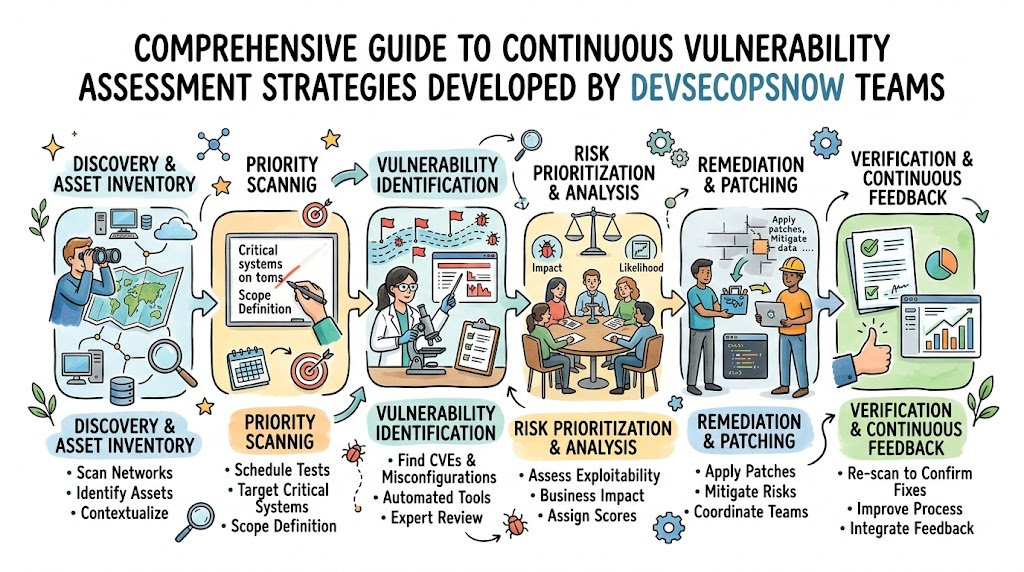
Effective security operations rely on an end-to-end vulnerability management cycle that handles discovery, validation, scoring, prioritization, team assignment, code remediation, fix verification, executive reporting, and continuous runtime tracking. Because automated security tools generate high volumes of alert data, teams must prioritize vulnerabilities using CVSS scores, exploit availability, application exposure, business criticality, sensitive data proximity, and internet accessibility. Prioritizing flaws based on actual business risk eliminates alert fatigue for developers, directs engineering bandwidth toward real threats, and speeds up remediation for exploitable security flaws.
DevSecOps Managed Services
Engineering organizations lacking dedicated internal security personnel gain continuous operational support through DevSecOps Managed Services. Managed service teams maintain daily platform operations, monitor security pipelines, tune automated scanners, triage vulnerability findings, and update policy guardrails. Beyond managing tools, external engineers provide developer fix guidance, cloud and Kubernetes security monitoring, pipeline optimization, and compliance reporting, freeing internal developers to build key product features securely.
Penetration Testing Services
Although automated security scanners quickly detect known software flaws and static misconfigurations, complete security validation requires manual Penetration Testing Services to identify complex operational vulnerabilities. Skilled security testers simulate real-world attacks against web portals, REST APIs, cloud configurations, network boundaries, Kubernetes clusters, container layers, and authentication controls. Unlike automated tools that search for basic signature matches, manual penetration testers find complex business logic defects, multi-stage attack chains, and authorization bypasses, providing definitive proof of an organization’s actual defensive strength.
DevSecOps Training
Establishing continuous security capabilities across teams requires detailed DevSecOps Training programs designed to educate technical staff on modern security engineering principles. Key training modules cover secure SDLC concepts, CI/CD pipeline defense, SAST/DAST/SCA tool operations, cloud and container security, secrets management, Infrastructure as Code scanning, SBOM handling, policy-as-code automation, and threat modeling. Teaching engineers these practical security skills turns security into an integrated capability shared across all development teams.
Corporate DevSecOps Training
Enterprises driving digital modernization rely on targeted Corporate DevSecOps Training programs designed for specific technical roles, internal platforms, and corporate delivery pipelines. Role-based learning tracks deliver precise technical depth for different job functions across engineering teams.
- Developers: Master secure coding rules, IDE security plugins, dependency updates, and rapid defect fixes.
- DevOps Engineers: Learn pipeline hardening, secure build agent setup, secrets automation, and release verification.
- Security Engineers: Focus on policy-as-code drafting, automated alert triage, tool integrations, and governance metrics.
- Platform Engineers: Study golden path pipeline design, platform template security, service mesh policies, and access controls.
- Cloud Engineers: Deep-dive into Cloud Security Posture Management, least-privilege IAM design, IaC validation, and cloud network defense.
- Engineering Managers: Track risk reduction metrics, remediation SLAs, culture enablement, and audit compliance mapping.
Utilizing interactive laboratory environments with technologies such as Jenkins, GitHub Actions, GitLab CI/CD, Docker, Kubernetes, Terraform, AWS, Azure, GCP, and SonarQube ensures engineers gain practical, real-world skills.
Example DevSecOps Pipeline
An automated DevSecOps pipeline executes multi-stage security checks directly within developer workflows, validating every code change from initial commit to live production.
Developer Commit ➔ Secrets Scan ➔ SAST ➔ Dependency Scan ➔ Build ➔ Container Scan ➔ IaC Scan ➔ Test Deployment ➔ DAST ➔ Policy Validation ➔ Production ➔ Runtime Monitoring
When a developer pushes code, the build runner instantly triggers secrets scanning and static code checks to detect hardcoded credentials and software flaws. Next, dependency management engines inspect open-source libraries before the build phase generates immutable container artifacts. Security tools then scan the container image for OS defects and evaluate Infrastructure as Code templates for cloud misconfigurations. Once initial checks pass, the runner deploys the app to a staging environment where dynamic testing engines execute external security attacks, followed by policy-as-code verification. After final release approvals, continuous runtime observability systems monitor live application behavior for active security threats.
DevSecOps Implementation Roadmap
Successfully building a continuous security program demands a structured rollout strategy that balances strict defense requirements with developer velocity.
Phase 1 – Assessment and Strategy
Audit current engineering toolchains, measure baseline security maturity, assess audit compliance needs, set clear business goals, and draft an enterprise transformation plan.
Phase 2 – Core Security Foundations
Strengthen security hygiene by setting up centralized secrets management systems, enforcing source control branch protection rules, and running threat modeling sessions on critical apps.
Phase 3 – Pipeline Integration
Integrate static code analysis, secrets detection, and dependency scanning into primary CI/CD pipelines using non-blocking alert modes initially.
Phase 4 – Infrastructure and Container Hardening
Deploy automated IaC scanning, base container image management standards, private registry vulnerability checks, and cloud posture monitoring.
Phase 5 – Policy-as-Code and Guardrails
Automate policy checks across Kubernetes admission controllers, cloud infrastructure deployments, and pipeline deployment gates using policy engines.
Phase 6 – Advanced Testing and Supply Chain Security
Deploy automated DAST tools into staging environments, automate SBOM generation, enforce digital code signatures, and secure build infrastructure.
Phase 7 – Runtime Protection and Observability
Implement runtime application self-protection, container threat detection, centralized security logging, and real-time incident alerting across production clusters.
Phase 8 – Continuous Optimization and Scale
Define risk-based vulnerability SLAs, automate alert triage workflows, measure security velocity metrics, refine policy guardrails, and scale practices across all product teams.
Common DevSecOps Challenges
Organizations transitioning toward continuous security models frequently encounter operational bottlenecks, cultural friction, and technical hurdles that demand practical solutions.
- Security Alert Overload: High volumes of false positives create developer fatigue; solve this by tuning scanner rules, suppressing minor findings, and prioritizing severe exploit risks.
- Developer Resistance: Release delays cause friction between teams; resolve this by embedding security feedback directly into developer IDEs and Git pull request screens.
- Tool Fragmentation: Managing isolated security tools creates operational silos; implement unified risk platforms that consolidate scanner findings into single dashboards.
- Lack of Security Ownership: Development teams often view security as an external task; launch security champion initiatives to cultivate shared responsibility within dev units.
- Skills Gaps: Engineering staff often lack application security skills; offer role-based training programs featuring practical hands-on exercises tailored to modern cloud tools.
- Poor Tool Integration: Standalone scanners disrupt automated pipelines; select extensible security tools featuring native pipeline plugins and robust API endpoints.
- Excessive Pipeline Delays: Slow security scans stall deployments; optimize build speeds by running heavy dynamic tests asynchronously outside main release pipelines.
- Inconsistent Security Policies: Manual compliance reviews lead to configuration errors; enforce security policies using automated policy-as-code guardrails across all environments.
DevSecOps Metrics
Tracking clear performance metrics helps engineering leaders evaluate program progress, optimize pipeline efficiency, and demonstrate concrete risk reduction over time.
| Metric | Purpose |
| Mean Time to Remediate (MTTR) | Tracks the average speed developers fix identified security defects. |
| Critical Vulnerabilities | Counts active, unpatched high and critical security flaws across environments. |
| Security Test Coverage | Measures the percentage of codebases and pipelines using automated security scans. |
| Secrets Detected | Tracks exposed credentials, API keys, and tokens caught before reaching production. |
| Dependency Risk Index | Evaluates the volume of vulnerable or outdated open-source dependencies in builds. |
| Policy Violation Rate | Measures non-compliance events caught by automated policy-as-code guardrails. |
| Secure Deployment Rate | Tracks the proportion of application releases passing all security checks cleanly. |
Evaluating these operational metrics ensures leadership makes data-driven security improvements rather than relying on subjective performance estimates.
Choosing a DevSecOps Service Model
Selecting the right engagement model depends on an organization’s technical capabilities, existing security maturity, available engineering bandwidth, and strategic business goals.
- DevSecOps Consulting Services: Perfect for enterprises needing architectural strategy, strategic transformation plans, audit guidance, and tool selection support.
- DevSecOps Assessment Services: Ideal for organizations seeking an independent review of their technical posture, pipeline gaps, and prioritized transformation plans.
- DevSecOps Implementation Services: Suited for teams needing hands-on technical help integrating SAST, DAST, SCA, secrets scanning, and IaC tools into pipelines.
- DevSecOps Managed Services: Designed for businesses wanting ongoing external management of security tools, scanning pipelines, and vulnerability triage workflows.
- Cloud Security Consulting Services: Essential for teams updating multi-cloud configurations, IAM access models, cloud networks, and workload protection systems.
- Kubernetes Security Consulting Services: Critical for engineering teams deploying production containers that require hardened cluster controls and runtime monitoring.
- Software Supply Chain Security Services: Important for businesses looking to secure external packages, enforce code signing, and maintain SBOM tracking.
- Penetration Testing Services: Recommended for organizations seeking manual attack validation to test their live security controls against real threats.
- DevSecOps Training: Great for individual technical professionals looking to gain practical skills in secure development, cloud defense, and pipeline automation.
- Corporate DevSecOps Training: Customized for enterprise companies seeking to upskill development, DevOps, security, and cloud teams through hands-on labs.
Frequently Asked Questions
1. What sets DevSecOps apart from traditional DevOps workflows?
DevOps focuses on combining development and operations to accelerate software delivery speed and release frequency. DevSecOps expands this approach by embedding automated security testing, policy guardrails, and compliance checks directly into everyday development processes, ensuring that fast software releases remain secure and resilient against cyber threats.
2. Why does shifting left improve application security efficiency?
Shifting left moves security evaluations to early software creation phases like local coding and pull requests. Catching security flaws early enables developers to fix code errors immediately, which drastically lowers fix costs, eliminates release delays right before launch, and prevents vulnerable code from entering live environments.
3. How does SAST integrate into automated developer workflows?
Static Application Security Testing (SAST) evaluates source code and project binaries for programming defects without running the software. Running SAST inside CI/CD pipelines allows scanners to evaluate pull requests automatically, providing real-time vulnerability feedback directly to developers before code merges into main development branches.
4. Why should engineering teams utilize Software Composition Analysis?
Modern applications rely heavily on external open-source packages that frequently contain software vulnerabilities. Software Composition Analysis (SCA) automatically inventories these dependencies, flags known security vulnerabilities and license risks, and notifies engineering teams the moment upstream maintainers publish secure component updates.
5. How do IaC scanners protect cloud infrastructure from errors?
Infrastructure as Code (IaC) scanners evaluate template scripts like Terraform and CloudFormation before cloud platforms execute them. Flagging insecure configurations like open storage buckets, permissive access rules, and unencrypted databases prior to deployment stops cloud security misconfigurations from ever entering live production environments.
6. Why do modern enterprises require a Software Bill of Materials?
A Software Bill of Materials (SBOM) provides a complete inventory listing every software component, library, and dependency inside an application. Organizations use SBOMs to maintain supply chain transparency, satisfy audit compliance demands, and quickly identify affected applications whenever new zero-day vulnerabilities emerge in widespread open-source packages.
7. How does policy-as-code automate security compliance?
Policy-as-code writes security rules and governance guardrails as executable code files managed in source control. Automated policy engines inspect infrastructure scripts, container manifests, and deployment pipelines against these files, enforcing compliance rules automatically and blocking non-compliant software releases without requiring manual security audits.
8. What core security domains are addressed in Kubernetes security consulting?
Kubernetes security consulting covers critical cluster protection areas like Role-Based Access Control (RBAC), pod network isolation, admission control rules, secrets protection, container image scanning, control plane hardening, runtime threat detection, and cluster access management across multi-cloud infrastructure environments.
9. What distinguishes manual penetration testing from automated security scanning?
Automated scanners evaluate source code and system settings against pre-configured vulnerability signature rules. Manual penetration testing involves experienced security experts actively simulating real attacks to discover complex business logic flaws, authorization bypasses, and multi-stage exploit paths that automated software tools miss entirely.
10. Why are software supply chain security services becoming crucial?
Cyber attackers frequently target third-party dependencies, build systems, CI/CD runners, and artifact repositories to breach enterprise networks through trusted software updates. Software supply chain security locks down build runners, dependency packages, and code signatures to guarantee deployed software stays authentic and untampered.
11. How do managed DevSecOps services assist internal engineering organizations?
Managed DevSecOps service providers handle day-to-day security platform management, pipeline monitoring, vulnerability triage, scanner configuration, and policy updates. Taking over these complex operational tasks frees internal development and DevOps teams to concentrate on delivering core product features safely and quickly.
12. How much time does a full corporate DevSecOps transformation require?
A corporate DevSecOps transformation typically progresses through structured rollout phases over six to eighteen months depending on company size, technical debt, and organizational culture. Initial pipeline scanning setup takes only a few weeks, whereas building full automation, policy-as-code guardrails, and strong security culture requires continuous effort.
Conclusion
Continuous security engineering changes modern software delivery by embedding real-time vulnerability checks, policy guardrails, cloud protection, Kubernetes hardening, and supply chain controls directly into CI/CD pipelines. Moving away from manual security checkpoints toward automated pipeline guardrails gives organizations full vulnerability visibility without lowering software release speeds. Implementing policy-as-code frameworks, structured risk prioritization, and practical role-based technical training enables cross-functional engineering teams to share security responsibility naturally. Ultimately, adopting a modern security framework establishes a resilient, scalable software delivery engine capable of defending against emerging cyber threats while driving operational performance.
Leave a Reply